


Cobots vs. Industrial Robots: Choosing the Right Automation Solution for Your Operation
As automation continues to reshape food processing and packaging operations, many manufacturers are weighing a key decision: collaborative robots (cobots) or traditional industrial robots.
Both technologies play important roles on modern production floors, but they are designed for very different use cases. Understanding the strengths and limitations of each is critical when evaluating automation investments for palletizing, case handling, assembly, and inspection-related tasks.
Below is a practical breakdown to help operations teams determine which solution best fits their production goals, space constraints, and throughput requirements.
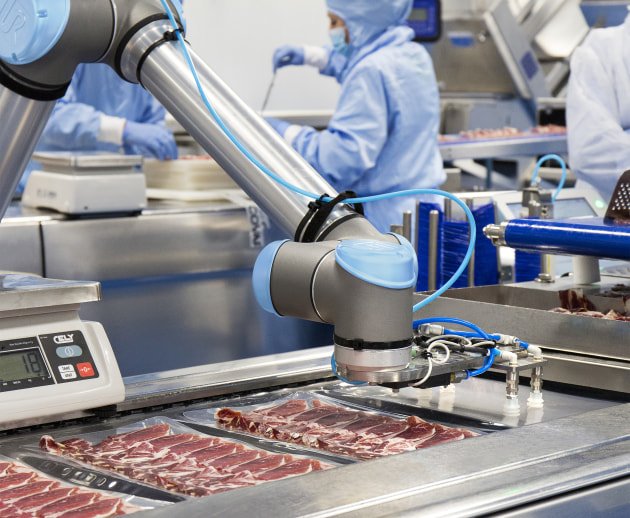
What Is a Collaborative Robot (Cobot)?
Collaborative robots, commonly referred to as cobots, are designed to operate safely alongside human workers. Unlike traditional industrial robots, cobots use built-in sensors and force-limiting technology to detect nearby people and automatically slow down or stop when contact is detected.
Cobots are often selected for applications that require flexibility, frequent changeovers, or close human interaction.
Common Applications
- Case packing and light palletizing
- Pick-and-place tasks
- Assembly assistance
- End-of-line support where space is limited
Key Advantages of Cobots
- Built-in safety features allow operation without full safety fencing
- Smaller footprint, ideal for compact or retrofit environments
- Faster deployment and simpler programming compared to traditional robots
- Lower upfront cost, typically around $150,000 depending on configuration
Limitations to Consider
- Reduced speed near humans, often limited to around 1 m/s
- Lower payload capacity, generally capped at approximately 66 lbs
- Not well suited for high-speed, high-volume production lines
Cobots excel in environments where human flexibility and automation must coexist, but they are not designed to replace industrial robots in demanding, high-throughput applications.
What Is an Industrial Robot?
Industrial robots are purpose-built for speed, precision, and repeatability. These systems are typically enclosed within safety fencing and operate with minimal human interaction, making them ideal for continuous, high-volume production.
Common Applications
- High-speed palletizing
- Heavy case handling
- Repetitive, long-cycle production tasks
- Fully automated packaging lines
Key Advantages of Industrial Robots
- Consistent high speeds, often up to 2 m/s without slowing
- Higher payload capacities, suitable for heavier products and tooling
- Excellent repeatability, supporting tight quality standards
- Designed for 24/7 operation in demanding environments
Limitations to Consider
- Larger footprint and requirement for safety fencing
- Higher total system cost, typically ranging from $175,000 to $200,000+
- Longer integration and commissioning timelines
Industrial robots are best suited for operations where throughput, consistency, and payload requirements outweigh the need for human collaboration.
Cobot vs. Industrial Robot: Key Differences at a Glance
| Feature | Cobot | Industrial Robot |
| Speed | Slows near humans | Consistent high speed |
| Payload Capacity | Up to ~66 lbs | Significantly higher |
| Safety | Built-in sensors | Requires fencing |
| Footprint | Compact | Larger |
| Typical Cost | ~$150,000 | $175,000–$200,000+ |
Choosing the Right Automation Strategy
The right automation solution depends less on the technology itself and more on how it aligns with your operation.
Cobots are often a strong fit for:
- Plants with limited floor space
- Operations requiring frequent changeovers
- Tasks that benefit from human-robot collaboration
Industrial robots are typically better suited for:
- High-speed, high-volume lines
- Heavy or repetitive material handling
- Fully automated packaging and palletizing systems
In many facilities, the most effective strategy is not choosing one over the other, but deploying both in different areas of the plant based on application needs.
Final Thoughts
Cobots and industrial robots are not competing technologies; they are complementary tools designed for different challenges. A clear understanding of production requirements, safety considerations, and long-term growth plans is essential when evaluating either solution.
If you are considering automation for your packaging or processing line and want help determining the right approach, working with an experienced system integrator can help ensure the solution fits both your current needs and future expansion.